
🎁 Free 30-day publishing fees on Pay-As-You-GO. Get 15% off when recruiting from the UserQ Panel, with code HELLO15
Human insights, Survey results, Trends
It’s hot, you’re thirsty, and you reach for a bottle of water without a second thought. But that simple act says more than you think.
Behind every choice sits a mix of trust, habit, and convenience. Do you buy the same brand every time? Do you refill at home, or stick to bottled? Even the smallest hydration decisions reveal how we think about safety, effort, and sustainability.
Curious to learn more, UserQ ran a UAE-wide study with 250 participants from our own community of testers. Our goal was to uncover what drives those choices and what they tell us about behaviour in a region that’s adapting to a more sustainability-conscious mindset.
Let’s start with the obvious. Bottled water dominates in the UAE.
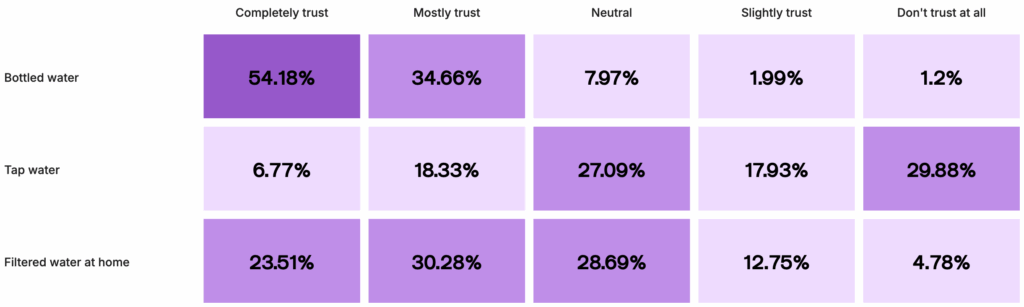
More than eight in ten respondents (81%) said they drink bottled water most often. Filtered water at home follows at 17%, while just 1% drink tap water without filtering it.
Nearly nine in ten people said they trust bottled water completely or mostly, compared with only one in four for tap water. Even filtered water, often seen as a safer middle ground, is trusted by only about half of respondents (54%).
In a country where staying hydrated is essential, people still choose what feels safest, not necessarily what’s most sustainable.
When choosing bottled water, taste (85%) and price (84%) clearly lead the decision-making process. These practical factors dominate because they feel immediate, familiar, and low-risk.
What’s striking, though, is that sustainability ranks nearly as high at 73%. People want to make eco-friendly choices, the intent is there, but it doesn’t always translate into action. This gap between awareness and behavior shows that environmental responsibility matters, yet it’s often overshadowed by convenience, habit, and unclear guidance.
Consumers in the UAE care about sustainability, but the system around them doesn’t always make it simple. Recycling points, refill machines, and filter options exist, but they’re fragmented, inconsistently located, and poorly communicated.
For researchers and designers, this presents a clear opportunity: make sustainable behavior visible, convenient, and trustworthy through better UX. Small, targeted interventions can make a big difference, for example:
When sustainability is visible, easy, and credible, intention finally turns into action.
We also asked: “Do you think all bottled waters taste the same?”
Over a third of respondents (37.45%) said yes, while 58.17% felt there are clear differences.
This split reveals something important about perception: for many people, bottled water choices are shaped less by taste and more by trust and familiarity. Whether or not taste differences truly exist, what matters is that people believe they’re choosing what feels safest and most reliable.
In the UAE, where bottled water is a daily essential, brand familiarity and availability strongly influence these habits. The most frequently purchased brands are Mai Dubai, Al Ain, and Masafi. These were mentioned by nearly two-thirds of respondents. These brands are easy to find, widely distributed, and have built consistent visibility over time.
When people choose a brand, they’re not necessarily responding to subtle sensory cues but to what’s reliable, recognizable, and within easy reach. For brands, this underscores that trust and presence often outweigh product differentiation, while for researchers and designers, it highlights the need to understand how perceived safety shapes everyday choices.
Sustainability awareness is growing in the UAE, particularly among the 25–44 age group, who made up the majority of our sample. Yet daily behavior doesn’t always reflect this awareness: water bottles remain the default choice for most people, even as the country works toward its long-term UAE Water Security Strategy 2036, which aims to ensure sustainable access to water for future generations.
This isn’t about rejecting sustainability, it’s about avoiding friction. People want to make eco-friendly choices, but not if those choices are poorly communicated, require extra effort, or create uncertainty about their real impact.
For designers and brands, the key is to make sustainable choices effortless, which means removing barriers and uncertainty so the eco-friendly option feels just as easy and trustworthy as the default one.
That could mean:
When people can see and trust the benefits, they act.
The UAE’s cultural diversity plays a significant role in how people perceive water quality and safety.
Respondents included Indian, Pakistani, Egyptian, and Filipino nationals, among others, each bringing their own experiences and expectations shaped by their home countries’ water infrastructure and habits. For some, bottled water represents safety and hygiene; for others, filtering or boiling water at home is the norm.
For researchers and brands, this means that clarity, transparency, and cultural sensitivity are essential. In a country where audiences don’t share a single cultural lens, consistency and clear communication become your strongest tools for building trust.
When information about water quality, sourcing, or sustainability is easy to understand, regardless of background, people feel more confident in their choices.
Water might seem like a simple topic, but it represents far more than hydration. It’s a mirror of human behaviour. Behind every bottle or refill choice lies a story about trust, awareness, and design’s power to shape daily decisions.
Understanding those stories turns assumptions into insight, and insight into action.
Ready to stop guessing and start knowing? Explore how to use UserQ or book a demo to see meaningful regional research in action.
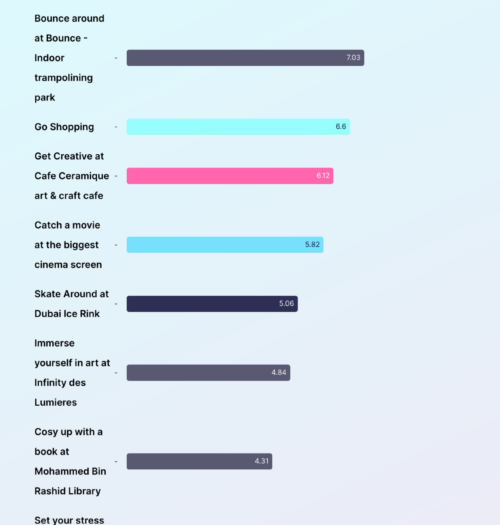
It’s raining in Dubai and we asked residents to rate their top inactivities (thanks to TimeOut Dubai) in order of
The four-day working week has been a talking point here in the UAE for quite some time now. In fact,
User research is typically a key part of product development and business growth all around the world, but here at

Receive emails about UserQ updates, new features,
offers and latest trends.