
AI adoption in the MENA region reached 50%. Here's why Arabic support is still the problem.

When 28% of users try a feature and abandon it, that’s usually a product failure. But when those same users report the feature as their most-wanted improvement, something more interesting is happening.

We surveyed 500 AI users across the MENA region (Egypt, the UAE, Saudi Arabia, and neighbouring markets) to understand how they’re using AI assistants and where the technology is falling short. The findings reveal a market that has moved far past experimentation. This isn’t early adoption anymore. It’s infrastructure.

80% of respondents use AI daily or multiple times a day. Half are paying for subscriptions. 83% plan to increase their usage in the coming year. But beneath these adoption numbers sits a more complex story about language, trust, and the gap between “good enough” and “good enough for professional use.”

Arabic support exists, usable Arabic support doesn't.

Better Arabic language support was the fifth most-requested premium feature in the survey, chosen by 36% of respondents. But that 36% figure becomes more significant when you look at who’s asking.

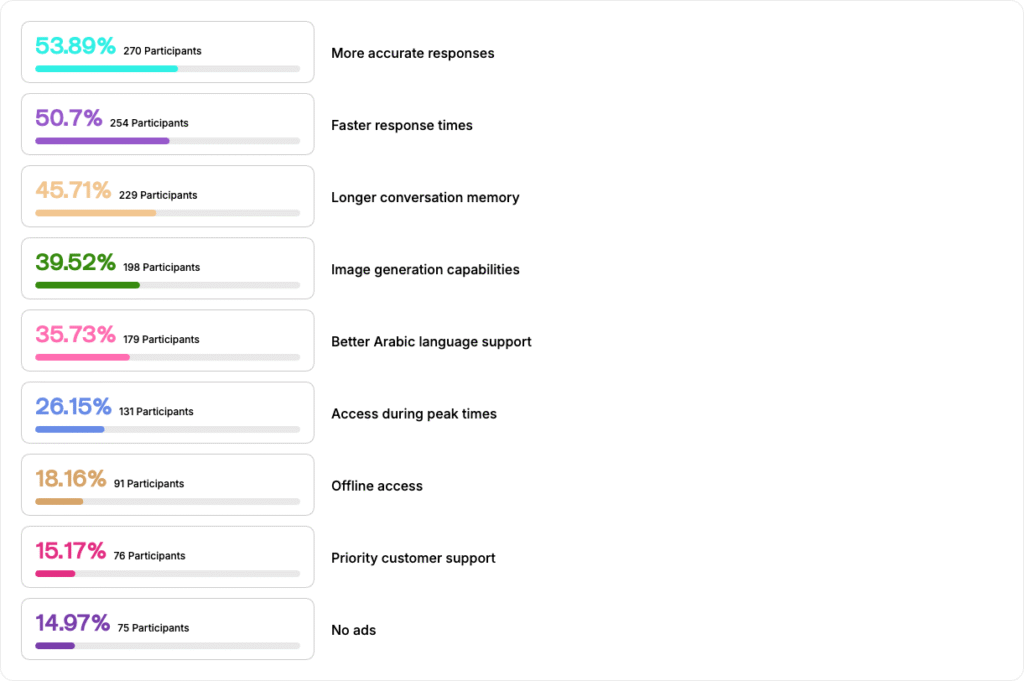
What would make an AI assistant worth paying for?

Two-thirds of users engage with AI in Arabic, either exclusively (17%) or mixed with English (48%). Of those who tried Arabic responses, 72% are still using it. That seems like a success until you examine the 28% who tried it and switched back to English permanently. That’s 111 people out of 390 who tested Arabic support and decided it wasn’t usable.

Their reasons weren’t about basic comprehension. The AI understood Arabic. It responded in Arabic. The problem was quality. Users described unnatural phrasing, grammatical errors, and dialect mixing that made the output feel awkward or unprofessional. Several mentioned cultural misunderstandings where responses were technically accurate but contextually wrong.

One user put it plainly: “I wanted Gulf dialect but got Modern Standard Arabic.” For anyone unfamiliar with Arabic linguistics, that’s like asking for conversational American English and receiving formal Victorian prose. Understandable, yes. Appropriate for a professional email, no.

This isn’t a peripheral problem. Users are making daily decisions about whether to work in their native language or in English because the quality gap is too wide to ignore. When you’re drafting a client email or writing a presentation, “mostly correct” isn’t good enough. The cost of awkward phrasing in a professional context is higher than the friction of switching languages.

The productivity gains are real, not rhetorical

81% of users report productivity gains. 45% save five hours or more per week. That’s a full workday reclaimed.

The tasks where AI shows up most frequently are telling: research and information gathering (61%), writing emails and messages (55%), learning new skills (45%), brainstorming and ideation (44%), and translating between languages (43%). These aren’t experimental edge cases. They’re core knowledge work activities.

What work tasks do you use AI for?

One software engineer described it like this: “After I started using Claude, I have started to enjoying writing code again. I went from a completely burnt-out engineer to having my own startup with an actual product.”

But the more interesting pattern is where users are applying AI. The largest group (41%) describe their usage as “about equally split between work and personal.” They’re not using AI as a productivity tool in one context and ignoring it elsewhere. They’re integrating it across how they think and operate.

One user mentioned AI helped with “recipe ideas and cooking help” in the same breath as “creating presentations and reports.” Another listed “homework help” alongside “meeting summaries.” The boundaries between professional tool and personal assistant have dissolved.

This matters because it shows how deeply AI has moved into everyday workflow. When someone is using the same tool to plan dinner and draft a client proposal, they’re not experimenting. They’ve integrated it into how they work.

Privacy concerns are genuine. They're just not stopping anyone.

60% of respondents cited privacy concerns about data being stored, shared, or misused. Yet 50% are paying for subscriptions, and 83% plan to increase usage. Only 15% identified privacy as an active barrier preventing them from using AI more.

This isn’t ignorance. Users aren’t unaware of privacy implications. They’re making a trade-off. The productivity gains outweigh the privacy risks, or they’ve accepted that there’s no alternative offering both.

This mirrors social media adoption from the 2010s. People expressed concern about data privacy on Facebook whilst simultaneously spending hours per day on the platform. The concern was genuine. The behaviour didn’t change.

The difference with AI is that the perceived value is higher. Social media offered connection and entertainment. AI offers time, the one resource that can’t be manufactured. When someone says they’re saving five hours per week, they’re not abandoning that tool over abstract privacy concerns.

But this acceptance isn’t static. Several users mentioned wanting clearer data policies. Others asked about private AI options or local-only processing. The market is signalling demand for privacy-preserving alternatives, even if that demand hasn’t yet translated into changed behaviour.

Workplace policy is catching up slowly

12% of users reported using AI for work without their employer’s knowledge. That’s 59 people in this sample operating in shadow IT territory, sharing work documents and potentially sensitive information with third-party AI platforms without organisational oversight.

Workplace policy is catching up slowly

The reasons vary. Some work at companies where AI use is prohibited (3% of the total sample). Others work where there’s no official policy (25%). Still others simply haven’t asked permission.

But the prohibition number is worth examining. Only 3% of workplaces in this sample have outright banned AI tools. That’s remarkably low. It suggests most organisations have recognised that prohibition isn’t viable. Employees will use these tools regardless. The question isn’t whether to allow AI, but how to enable it safely.

The policy landscape looks like this: 44% work in environments that actively encourage AI use, 19% face restrictions or limited approval, 25% report no official policy at all, and 9% don’t know if there’s a policy.

That last figure is perhaps the most telling. Their organisations may have communicated something about AI, but the message hasn’t reached everyone. Or the policy exists but isn’t being enforced. Either way, there’s a gap between organisational intent and employee understanding.

The users in the most productive category (those saving 5+ hours per week) are more likely to work at companies that encourage AI use. Companies that enable AI adoption are giving their employees tools that competitors’ employees lack. That productivity gap will compound over time.

Payment behaviour reveals genuine value

A 50% paid conversion rate is extraordinary for consumer software. For context, Spotify converts roughly 45% of free users to paid. Netflix sits around 60%. The MENA AI market is performing at the high end of that range.

These aren’t trial-driven conversions where users sign up for a free month and forget to cancel. These are deliberate purchasing decisions. The split shows 174 free users (35%) and 250 paid users (50%), with another 76 (15%) considering it.

Among paid users, ChatGPT Plus dominates with 181 subscribers (72% of the paid market). Claude Pro has 34 subscribers (14%), and other paid AI services account for 35 (14%).

What makes users pay? The top requested premium features tell the story: more accurate responses (54%), faster response times (50%), longer conversation memory (45%), image generation (40%), and better Arabic language support (36%). Users aren’t asking for frivolous features. They’re asking for the tool to work better in their language and context.

The 29% who answered “maybe, depends on features” represent a clear conversion opportunity. These aren’t users who’ve rejected the idea of paying. They’re users who haven’t yet seen enough value to justify the cost.

What this means for product teams

The findings cluster around three clear themes.

First, language quality matters more than language availability. Users can access AI in Arabic today. What they can’t access is AI that produces Arabic text they’d be comfortable sending to a colleague or client. The gap between “technically functional” and “professionally usable” is where the opportunity sits. With 66% of users engaging in Arabic and 36% listing better Arabic support as a top premium feature, this isn’t a niche concern.

Second, productivity gains are driving adoption faster than organisations can respond. The 12% shadow IT figure and the 25% “no policy” figure indicate that employees are moving ahead of institutional readiness. Product teams should consider this a tailwind, but it also means enterprise features around compliance, data handling, and access controls will matter more as organisations catch up.

Third, users are willing to pay for tools that genuinely save time, but they’re feature-sensitive. The 29% who answered “maybe, depends on features” represent clear conversion opportunity. Privacy transparency (honest, plain-language explanations of data handling) would address the stated concern of 60% of users without requiring fundamental product changes. Workplace adoption support (policy templates, training materials, compliance guidance) would help the 25% operating without clear direction.

The market has moved. 80% daily usage. 50% paid conversion. 83% planning to increase usage. These aren’t early adopter numbers. This is mainstream adoption. The question now isn’t whether AI assistants will become critical productivity tools in the MENA region. They already are.

This research was conducted using UserQ’s research panel. If you’re building for Arabic-speaking markets and need to understand your users better, reach out – we can help you run studies like this one!

Leave a Comment

Subscribe to our
product newsletter!

Receive emails about UserQ updates, new features,
offers and latest trends.

    Footer Logo Transparent

    Say goodbye to assumptions in product research and get real feedback from local users with the first user research platform in MENA.

    PRICING

    TESTERS RECRUITMENT

    RESOURCES


    Copyright © 2026 UserQ – A Digital of Things company

    I’m a researcher

    I want to use UserQ to publish tests and get results

    I’m a tester

    I want to use UserQ to take tests and get paid