
🎁 Free 30-day publishing fees on Pay-As-You-GO. Get 15% off when recruiting from the UserQ Panel, with code HELLO15
Human insights, Survey results
The Middle East’s digital economy has taken notable strides over the past decade due to several factors, including proactive digital transformation projects and government-led innovation initiatives. That said, growth alone does not define user experience, but a mix of language, culture, and localisation strategy.
Although English has remained the primary language across enterprise software and global tech platforms, the success formula changes across the Middle East, where Arabic plays a crucial role in shaping how users make decisions, determine trust, and engage with digital products.
Our recent survey on Arabic digital experiences presents a few key points:
Let’s dig deeper to discover the nitty-gritties of language preference patterns in digital journeys.
But first, let’s get to know our participants.
Our participants come from different backgrounds, nationalities, ages, and income groups.
Around 38% of respondents, from a pool of 504 participants, are between 26 and 35 years old, followed by 32% in the 36-45 age group. This reflects that the core segment of the respondents is young professionals who actively drive the adoption of digital products.
The participants come from different parts of the MENA region, with a majority of them from Egypt (41.47%), the United Arab Emirates (31.55%), and Saudi Arabia (14.88%).
Moving on to the educational qualifications of our participants. While 67% have a bachelor’s degree, 20% hold a master’s degree.
We strongly believe that a survey’s results will only tell the real story when the participants are genuine and a good fit for the survey. Before proceeding with the survey, we asked our participants a few pre-screening questions to ensure we were gathering insights only from individuals who interacted and engaged with Arabic digital products frequently.
The screening questions were:
Language preferences across digital environments are largely influenced by identity, and our findings establish that.
A whopping 83.53% of participants picked Arabic as their mother tongue, while only 8.74% said English is their first language.
However, the trend sees a significant shift when it comes to decision-making and reading.
Here’s what our survey discovered:
What does this data tell us?
Although Arabic defines linguistic identity, around 40% of respondents toggle between English and Arabic, depending on platform familiarity, task complexity, and context. It is crucial to note that although Arabic is the preferred and trusted language, English is also relevant for professional and functional use cases.
While the last section reveals the language preferences during reading and decision-making, we wanted to understand the comfort level of our survey participants while using digital services in Arabic.
Here’s what we found:
What this tells us is that nearly half of the respondents explicitly prefer Arabic user interfaces. However, the survey results also tell us that while 53.17% are comfortable with English and Arabic, around 32.14% prefer only English user interfaces.
This data not only highlights the bilingual adaptability of users, but it also sends a clear message to product teams: localisation strategies must focus on designing experiences that cater to bilingual navigation patterns, wherein users can seamlessly switch between Arabic and English as and when required.
Now that we know the preferred languages for reading, decision-making, and the comfort level of our participants with English and Arabic, it is a good time to discover the most popular types of digital services.
We asked them to select all the digital services they use at least once a week, and this is what we found.
High frequency categories:
Medium frequency categories:
Low-frequency categories
This data offers product teams insights into the high-demand or most popular digital services categories, enabling them to prioritise language optimisation accordingly.
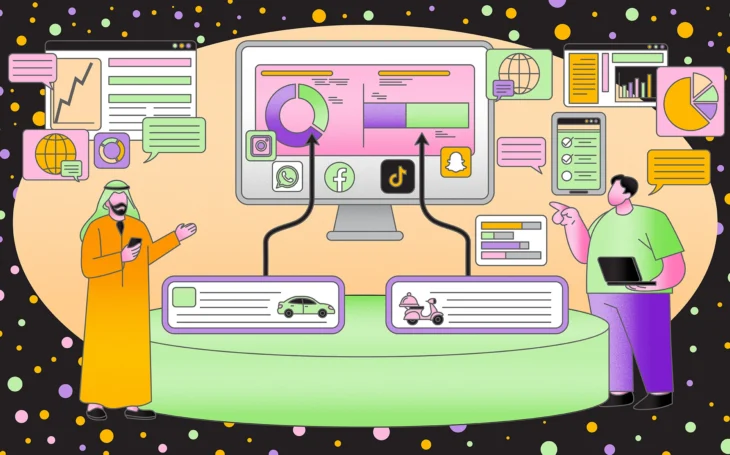
Now, we wanted to know which digital services our participants used in Arabic over the past week, and once again, it establishes Arabic’s strong dominance across the realm.
Here’s where our participants used Arabic the most:
The strong usage of Arabic across social media apps does not come as a surprise. In fact, it is expected. The real insights come from banking, payments, government services, and shopping: all high-trust, high-accuracy landscapes.
With over 50% of the population comfortable with Arabic to make financial transactions, it is clear that it is the default language for outcome-driven and serious interactions. Additionally, Arabic is also widely used in e-commerce and food delivery, indicating the strong inclination for Arabic interfaces.
Arabic is going beyond content consumption and quickly becoming an integral part of transactional ecosystems.
Although Arabic is widely embraced and the most preferred language among a majority of respondents, they have no qualms about switching to English due to various factors we will discuss ahead.
Around 48.81% of respondents indicated that they prefer starting their digital experiences in Arabic but tend to switch languages if the translation feels unclear. This is one of the primary factors triggering language switching. Therefore, it is critical to treat translation quality as one of the key parameters that influence user behaviours.
Our survey also reveals that 38.69% of participants start their digital experiences in English and switch to Arabic, particularly while performing crucial tasks, including payments, legal acknowledgement, etc.
Again, this reinforces our earlier finding: Arabic is the language of trust and final decision-making.
The earlier sections highlight the strong preference for Arabic, particularly for transactions, shopping, e-commerce, and accessing government services. However, users do not hesitate to switch languages if they are not satisfied with the translation quality, Arabic user interfaces, or lack clarity.
Here are some of the key trends that emerge from the responses we gathered.
This is one of the most repeated themes across our survey. The survey respondents have remained consistent and indicated they prefer Arabic for money transfers, banking apps, government platforms, and legal offices.
Why? Clarity, strong command of the language, and avoiding legal and financial mistakes.
A majority of respondents mentioned they prefer English while browsing through social media platforms, including Instagram, LinkedIn, Facebook, etc, due to habitual tendencies and easier navigation. Additionally, they also opt for English here since it is the main language across the global content ecosystem.
The adoption of Arabic interfaces across the MENA region is strong primarily due to the strong presence of Arabic speakers and linguistic identities here. However, users have pointed out areas where Arabic interfaces fall short.
Out of the 504 respondents, a staggering 75.4% said that translation quality and accuracy are the biggest friction points in Arabic digital experiences.
Some of the other areas of improvement include:
The previous section highlights the shortcomings of current Arabic user interfaces, and clear patterns emerge: translation, accuracy, tone, and word choice matter. The next step is to know what form of Arabic digital services to use.
Although Modern Standard Arabic is likely to be the anchor language, particularly in legal and financial contexts, a hybrid between localised and MSA is required for lifestyle, retail, and conversational interfaces.
In a nutshell, while MSA builds authority, localised Arabic builds connection.
Based on our findings, we expect Arabic to continue to shape digital experiences across the Middle East. That said, localisation alone may not help gain user trust; focusing on clarity, language optimisation, and strategic design remains the key.
Although the bilingual user base highlights the primary use cases of both languages and the major friction points that trigger language switching, both languages have clear areas of dominance: Arabic for banking, government, and financial, and English for social and global platforms.
The key is to treat Arabic as a core product layer and not a translated afterthought to ensure long-term growth, loyalty, and engagement.
If you are interested in knowing about the preferences of the diverse user base across the MENA region to build and market your digital products, you are at the right place. At UserQ, we help you uncover precious user insights with our on-demand research platform that connects you with real users across the region.
Get to the bottom of what your users really want, their preferences, friction points, and more.
It’s raining in Dubai and we asked residents to rate their top inactivities (thanks to TimeOut Dubai) in order of
The four-day working week has been a talking point here in the UAE for quite some time now. In fact,
User research is typically a key part of product development and business growth all around the world, but here at

Receive emails about UserQ updates, new features,
offers and latest trends.