
🎁 Free 7-day publishing fees on Pay-As-You-Go. Get 15% off when recruiting from the UserQ Panel, with code HELLO15
Human insights, Research, Survey results
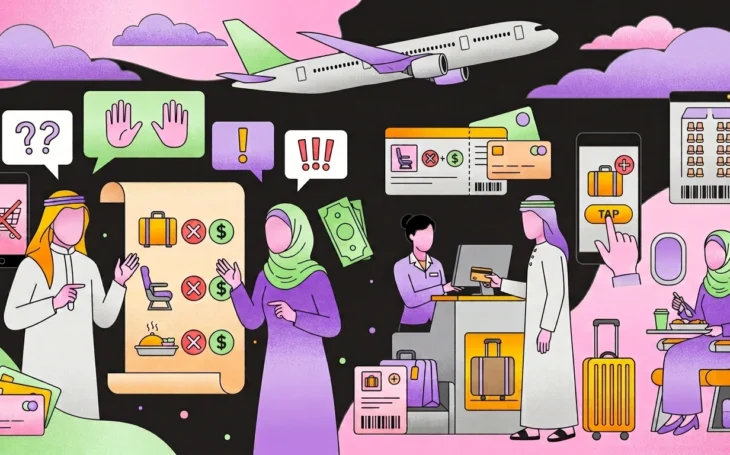
82% of the UAE flyers in our survey said paying for extras feels unfair when the fare is already high. Yet 96% had paid for at least one extra in the past year.
If you set prices or design booking flows, that gap matters. What people say about price and what they actually buy are not always the same. This post looks at where the two differ, where they match, and what that means for airlines and product teams.
We surveyed 252 UAE residents who had taken at least one return flight in the past 12 months.
The sample was split evenly by gender, with a median age of 35. Most live in Dubai (69%), and two thirds usually fly economy. Emirates was the airline respondents flew most often (56%), followed by Air Arabia (15%), with Etihad and flydubai at 10% each. The largest nationality groups were Indian (27%) and Pakistani (20%).
Beyond the 82% who find extras unfair on a high fare, 72% agree that airlines charge too much for them. Yet almost half the sample (48%) buy at least one extra on most or every trip.
The clearest gap came from asking the same thing in two ways. Half of respondents agreed they would rather pay a higher fare with everything included. But when we gave them an actual choice between a higher all-inclusive fare, a lower fare with paid extras, or “it depends on the trip”, only 17% picked the all-inclusive option. Another 31% chose the lower fare, and 52% said it depends.
Agreeing with an idea costs nothing. Choosing it means picturing the higher price, and most people stepped back. A team that read only the agreement question might build an all-inclusive fare for an audience that wants to decide trip by trip.
Seat selection showed a different version of the same split. It was ranked the most important extra (37% put it first), and 78% had paid to choose a standard seat in the past year. Yet 71% would pay AED 100 or less, or nothing, to choose a seat on a AED 2,000 fare. People clearly care about choosing their seat, but most think it should cost little or nothing.
“The most frustrating fee is paying extra just to choose a standard seat. After already buying the ticket, being charged simply to avoid a random middle seat feels unnecessary and makes the advertised fare seem misleading.” – Economy flyer
Then there is switching. 63% agree they have chosen a different airline because of extra fees, and 62% say they would be likely to switch to save AED 200 on extras. Low-cost carrier flyers (Air Arabia and flydubai) were more willing than Emirates flyers, 74% vs 53%, and the gap holds among economy flyers alone (80% vs 58%).
But every one of those figures is self-reported. People may be switching as often as they say, or that may be how they prefer to see themselves as shoppers.
Baggage is where the frustration is easiest to see.
When asked to pick the one extra they would most want included free, 40% chose checked baggage. That is almost three times the next choice, seat selection, at 14%.
The open question, which asked for the most frustrating fee people had paid or would least want to pay, told the same story. About 99 of the 252 answers (39%) were about baggage, more than any other fee. Cost was the most common complaint, with around 43 answers mentioning price or a specific amount. A smaller group, around 16, described unclear rules, surprise charges or paying at the airport.
About 18 baggage answers were about something narrower: being charged for going between 500g and 2kg over the limit.
“The 60 dollar overweight baggage fee at Dubai Airport. My bag was 2kg over and they charge me full extra bag price. I had to open my luggage at the counter and move stuff to my hand luggage. So embarrassing and feels like a rip-off.” – Economy flyer
Most flyers will pay for a bag. 41% would pay up to AED 150 for an extra 23kg, and only 19% would skip it. The complaint is about how much it costs, how hard that cost is to predict, and, for some, being hit with it at the counter.
Does baggage frustration push people to other airlines? Not clearly. Flyers who picked baggage as their free extra were only slightly more likely to report switching than everyone else (67% vs 60%), and a gap that small could be down to chance. Baggage is the fee people resent most, but this data can’t show that it’s the fee deciding where they fly.
Most flyers will pay for flexibility. 83% would pay extra to be able to change or cancel their ticket, close to the 81% who would pay for an extra bag or a seat. 76% had paid for a flexible or refundable fare in the past year, and a quarter ranked it their most important extra. Spending stays modest, though. The most common answer was up to AED 100 (38%), and only 11% would pay more than AED 250.
Paying with loyalty points was popular too. 83% said they would be likely to use points for extras, and only 5% said they would be unlikely to.
Other extras matter to fewer people. 42% already get free lounge access, for example through a credit card, and about half of the rest (51% of 147) would not pay for it. A third (32%) would pay nothing for Wi-Fi, and the most common answer among the rest was up to AED 25. 39% would skip extra legroom entirely.
One extra we didn’t ask about came up anyway. About 1 in 12 respondents raised paid meals, water or snacks in the open question, unprompted.
UAE flyers resent airline extras, and they buy them anyway. The 82% who call fees unfair and the 96% who paid for one are largely the same people.
For airlines, the clearest opportunity is in baggage and total price, and neither requires cutting what extras cost. With 86% of flyers saying they compare the total price before booking, showing a fare with a checked bag on the comparison screen, rather than only at checkout, puts the real price in front of them at the moment they compare. That matters most for low-cost carrier flyers, the group most willing to switch. Per-kg pricing, a small weight tolerance or a prompt to add weight online before travel would go straight at the baggage complaints.
Beyond that, the data points to matching the offer to the cabin. All-inclusive fares appeal far more to premium flyers (69% agreed) than to economy flyers (41%), who would rather choose extras trip by trip. Flexible fares and paying with points are the easier wins, with broad if modest appeal.
The useful question for a product team is rarely whether people dislike a fee, because most will say they do. It’s what they do when the fee is on the screen in front of them. Answering that, including what a bag or a seat should actually cost, takes more than a survey of attitudes, and a dedicated pricing study would be the natural next step.
This study was run with 252 respondents from the UserQ panel. If you are planning pricing or product research with audiences in the UAE or the wider MENA region, you can set up your own research project for free on UserQ.
It’s raining in Dubai and we asked residents to rate their top inactivities (thanks to TimeOut Dubai) in order of
The four-day working week has been a talking point here in the UAE for quite some time now. In fact,
User research is typically a key part of product development and business growth all around the world, but here at

Receive emails about UserQ updates, new features,
offers and latest trends.