Respondents answered on a five-point scale, from “completely trust” to “not at all.” High trust groups “completely” and “mostly.” Low trust groups “slightly” and “not at all.” The two columns don’t add up to 100% because a third answer, “somewhat trust,” sits in the middle and isn’t shown here.
For anything informational or task-based, trust sits above 70%, often close to 80. The moment a question moves from “help me understand something” to “help me decide something that could go wrong,” trust roughly halves, and the share of people who actively distrust the tool for that purpose triples or quadruples.
That swing shows up in the same population, using the same tools, holding two genuinely different levels of confidence depending on what’s being asked of them.
Why the cliff exists
The concerns data points at the answer, and it’s more mundane than a philosophical objection to AI. Privacy was the single most common concern in the whole survey, named by 80% of respondents. Accuracy came second, at 55%. Compare that to more abstract worries like job displacement (39%) or bias (29%), and a pattern emerges: people aren’t worried about what AI represents. They’re worried about what happens if it’s wrong, or where their data ends up, when the answer actually matters.
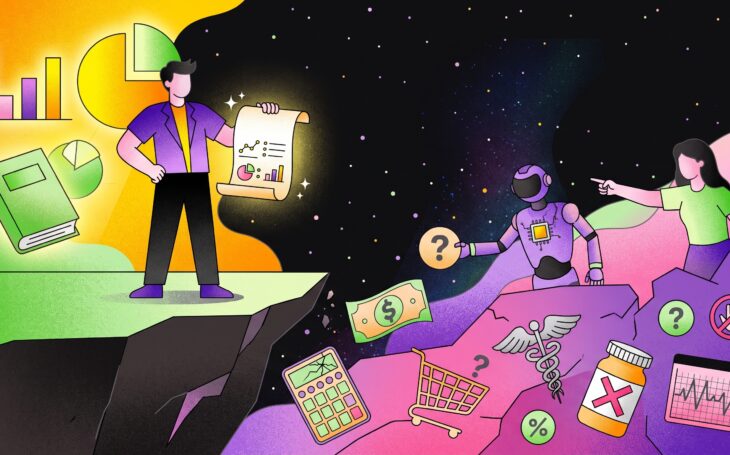
That reframes the trust cliff usefully. It reads less like hesitation about AI as a category and more like a rational response to consequence. People are comfortable being wrong about a fact they can Google-check. They’re a lot less comfortable being wrong about their money or their health, especially when the tool giving the answer sounds exactly as confident either way.
What this means if you’re building or researching AI products
The obvious mistake here is treating “trust in AI” as a single number to move, when it’s really a different question in every domain. A product or feature that earns trust for research or writing tasks has earned nothing yet in a financial or health context. Those need their own evidence, their own transparency, and often their own UI decisions, things like showing sources, flagging uncertainty, or making it easy to verify a claim before someone acts on it.
For researchers specifically, this is a reminder to stop asking “do you trust AI” as a standalone question. It doesn’t tell you much. Ask it per task, per domain, per decision, and you get something you can actually design against.
The same logic points to where the real risk sits for any product layering AI into high-stakes decisions. Users aren’t blindly trusting the output either, this data suggests they’re already sceptical exactly where scepticism is warranted. The risk is a product that doesn’t give them a way to act on that scepticism, no way to check, question, or verify before they commit to something that matters.
That instinct, drawn from a sample that already uses AI daily and trusts it plenty in the right places, might be one of the more useful signals in the whole study.
This study is part of UserQ’s ongoing research into the India market. If there’s a specific market you’re trying to understand better, India or otherwise, get in touch and let’s talk about what a study could look like. Or if you’ve already got a question in mind, you can go ahead and set up your own research project on UserQ.